Brief Introduction to Horizon Europe:
Horizon Europe is the European Union's framework programme for research and innovation. The programme runs from 2021 to 2027 and has a budget of 95.5 billion euros (in current prices).
Participation in Horizon Europe is open to universities, research institutions, and companies.
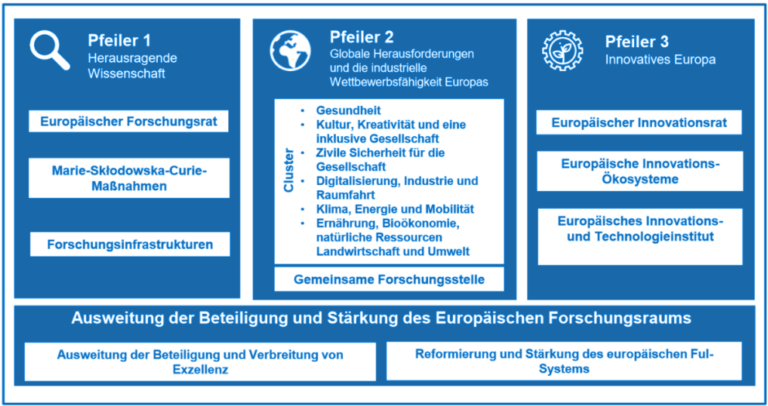
Horizon Europe is divided into three programme areas with different funding priorities.
Special Features of Horizon Europe
| Subject of Funding | Horizon Europe funds pre-competitive activities in the fields of research and development as well as demonstration and product development. |
| Type of Projects | The projects offer the opportunity to work together with the best institutions in Europe. They have high budget volumes and long durations. Depending on the funding instrument and institution, the funding rate is up to 70% or 100% of direct costs plus a 25% flat rate for indirect costs. |
| Funding Instruments | Mainly collaborative projects are funded, in which at least three actors from different EU member states or associated countries cooperate. In addition, there are instruments that allow for individual funding. |
| Publication of the Calls | The calls are published in thematic work programmes. The first work programmes are expected in spring 2021. The latest information on the calls can be found on the Participant Portal. Applications must also be submitted and projects managed through the portal. |
| Evaluation Criteria | The applications are assessed by neutral reviewers in a peer-review process based on three criteria: Excellence: scientific excellence of the project and level of innovation Impact: expected impact of the project Implementation: implementation of the project and quality of the consortium Depending on the programme area, the criteria are weighted differently. Only projects that reach a minimum score are eligible for funding. |
| Success Rate | The European Commission ranks the reviewed and eligible projects in a funding order (main list). It funds projects until the budget available for that call is exhausted. The success rate therefore depends on the budget and the number of applications submitted, and varies for the individual parts of the programme. Experience from Horizon 2020 shows that the success rate varies between 6% and 45%. On average, it is around 20%. Since there have not yet been any calls under Horizon Europe, no statement can yet be made regarding the new framework programme. |
| Classification of Technological Maturity | Most calls include information on the technological maturity that research projects must demonstrate or reach at the outset. The Technology Readiness Level (TRL) instrument is used for this purpose. The scale starts with basic research (TRL 1-3), progresses through applied R&D (TRL 4-5) and demonstration (TRL 6-7), and concludes with a market-ready product (TRL 8-9). |
| Time to Grant |
The period between application submission and contract signing for successful applications should be no more than eight months. In order to carry out the process within this timeframe, renegotiations between the European Commission and the project coordinator are no longer planned. Reviewers' suggestions for improvement are also no longer taken into account during contract negotiations. |
| Citizen Participation | Citizens are to be more strongly involved in Horizon Europe, and the positive benefits of research and innovation — for example, through progress in health or the environment — are to be communicated even more clearly. This applies both during and after projects and is in line with the "third mission" mandate of universities alongside research and teaching. This makes it possible to convey socially relevant topics such as genetic engineering in agriculture, questions about IT developments (blockchain), or issues of mobility. |
| Impact Pathways | Impact pathways are used to illustrate the orientation and results-focus of EU funding for research, business, and society. They define the indicators for evaluating funding applications and the funding programme itself. Horizon Europe distinguishes between three impact areas: scientific impact, societal impact, and economic/technological impact. |
| Open Science | Open Science is intended to lead to better dissemination and exploitation of research and innovation results and to support active engagement by society. Mandatory open access to publications is intended to ensure that beneficiaries — or the authors — retain sufficient intellectual property rights. Open access to research data is ensured according to the principle "as open as possible, as closed as necessary." This is done in accordance with the data management plan for FAIR (Findable, Accessible, Interoperable, Re-usable) and open research data. These principles are intended to support researchers' capabilities and reward them for open science. To this end, researchers are to have access to the European Open Science Cloud. |
| European Partnerships | European Partnerships are initiatives in which the EU Commission and private and/or public partners commit to jointly supporting the development and implementation of a research and innovation programme. In total, 49 partnerships are intended to thematically complement the classic calls in Horizon Europe. A budget of more than 23 billion euros has been allocated for them. |
| Missions | The missions emphasize the following priorities: adaptation to climate change, cancer, climate-neutral cities, soil/food, and healthy oceans and waters. In these areas, the EU relies on a strong interlinking of funding instruments and the topics put out to tender in order to achieve greater visibility and effectiveness for its policy goals, which are largely aligned with the UN's sustainability goals. |
| Cascade Funding | Cascade funding is a mechanism that allows beneficiaries to distribute the funds granted to them under Horizon 2020/Horizon Europe or other programmes such as Interreg, ERDF, etc., to third parties in the form of sub-granting financial support (following a call for proposals) or in the form of prizes. |
Support
Advice and support for applications and projects, as well as assistance with partner search and consortium building, can be found
at the state level, among others, through the
- ZENIT GmbH / NRW.Europa
- EU offices at universities and research institutions in NRW
at the federal level, among others, through the
- National Contact Points
- EU Liaison Office of the Science Organisations (KoWi)
- EU Office of the Federal Ministry of Education and Research (BMBF)
Information
- Portal of the European Union
- Ministry of Culture and Science of the State of North Rhine-Westphalia (MKW)
- ZENIT GmbH / NRW.Europa
- German Portal of the Federal Ministry of Education and Research (BMBF)
Social Media
You can also find current information on the social media channels under the hashtag
#horizonEU